
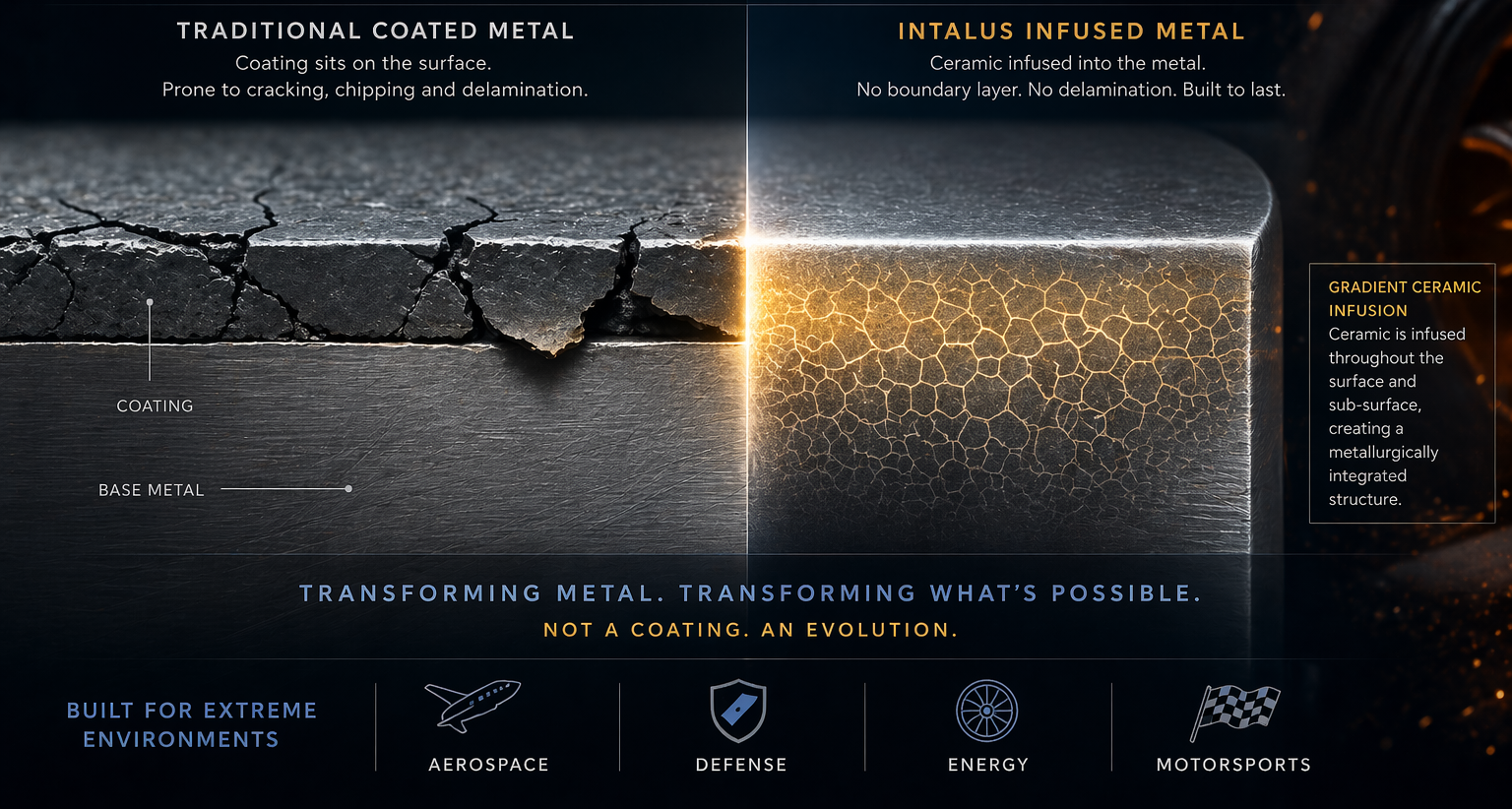
The hardest-working metal parts in the world (landing gear, hypersonic leading edges, undersea actuators, high-performance brakes) share a common weakness: their surfaces. For decades, the fix has been the same: add something on top. Paint, plating, thermal spray, PVD. Every one of those is a coating, and coatings can fail at the interface under demanding operating conditions. They can delaminate, crack, and wear through, often taking the part with them.
Origin Ventures VI’s latest investment, Intalus, takes a different approach. Rather than coating a part, Intalus transforms it. The company’s patented Targeted Phase Infusion (TPI) process embeds ceramics directly into the metal itself, so the part becomes harder, more wear-resistant, and more resistant to corrosion and oxidation without a separate layer that can fail. Typical results are significantly better than conventional treatments in the performance metrics that matter most, including hardness, corrosion resistance, and useful life.
Origin Ventures VI led Intalus’s $11M Seed financing alongside Lockheed Martin, Scout Ventures, and others.
Where coatings reach their limits
Mission-critical parts in defense, aerospace, energy, and heavy industry live in punishing environments. They grind, corrode, and cycle through temperature extremes that conventional coatings (PVD, thermal spray, cladding, hard chrome) often struggle to withstand long operating cycles. When the coating fails, the part fails, and in most of these applications that means expensive downtime of entire systems; equipment that can’t afford to be offline.
The supply side of the problem is just as ugly. Most of the world’s advanced hardened-metal manufacturing capacity sits overseas, and U.S. regulators are accelerating the phase-out of the legacy chemistries that remain (chromium in particular). Major manufacturers are actively hunting for alternatives.
What Intalus does differently
TPI doesn’t sit on the part. It becomes part of the part. Because the ceramic is infused into the metal rather than layered on top, there’s no discrete coating interface to delaminate. A TPI-treated component is designed to withstand levels of wear and environmental exposure that challenge conventionally coated parts, and it can be integrated into existing manufacturing and maintenance workflows with minimal disruption, depending on the application.
Why now
Three things are pulling in Intalus’s direction at the same time. The U.S. defense and maritime industrial base is being rebuilt with urgency, and advanced materials capacity is a named chokepoint. The energy transition (hydrogen, nuclear, renewables) is putting new demands on part durability that coatings can’t meet. And regulators are forcing substitution away from legacy toxic chemistries on a firm timeline. Intalus sits in the middle of all three.
Traction
Intalus’s early customer list reads like a map of the hardest problems in manufacturing: Formula 1, the Department of Energy, the Department of Defense, a global consumer electronics OEM, and an undersea UUV defense program, with active discussions across hypersonic and aerospace propulsion primes. The company’s production hub is being built out at Purdue’s Hypersonic Advanced Manufacturing Technology Center (HAMTC) in West Lafayette, Indiana, which puts it inside one of the strongest advanced-manufacturing ecosystems in the country.
Team
Intalus was founded by CEO Gene Skiba and co-founder Peter Ostlund, who have spent nearly a decade developing the company’s materials platform and advancing it toward commercial deployment. They are hands-on builders with deep credibility across the industries Intalus serves, including defense, motorsport, and energy.
How Intalus fits Origin Ventures’ thesis
Intalus extends the deep-tech and advanced-manufacturing thread that runs through Origin Ventures VI. Our investment in Torus targets energy and storage for AI data centers. H3X is electrifying planes, ships, and heavy industry. Silkline is re-wiring procurement for advanced manufacturers. Intalus unlocks something upstream of all of them: the materials themselves. When the next generation of machines demands parts that can survive conditions the last generation couldn’t, we want a company like Intalus producing them.
We’re excited to partner with Gene, Peter, and the Intalus team as they bring Targeted Phase Infusion to the industries that can least afford to have their hardest parts fail.